A whitelist or allowlist is a list or register of entities that are being provided a particular privilege, service, mobility, access or recognition. Entities on the list will be accepted, approved and/or recognized. Whitelisting is the reverse of blacklisting, the practice of identifying entities that are denied, unrecognized, or ostracized. == Email whitelists == Spam filters often include the ability to "whitelist" certain sender IP addresses, email addresses or domain names to protect their email from being rejected or sent to a junk mail folder. These can be manually maintained by the user or system administrator - but can also refer to externally maintained whitelist services. === Non-commercial whitelists === Non-commercial whitelists are operated by various non-profit organizations, ISPs, and others interested in blocking spam. Rather than paying fees, the sender must pass a series of tests; for example, their email server must not be an open relay and have a static IP address. The operator of the whitelist may remove a server from the list if complaints are received. === Commercial whitelists === Commercial whitelists are a system by which an Internet service provider allows someone to bypass spam filters when sending email messages to its subscribers, in return for a pre-paid fee, either an annual or a per-message fee. A sender can then be more confident that their messages have reached recipients without being blocked, or having links or images stripped out of them, by spam filters. The purpose of commercial whitelists is to allow companies to reliably reach their customers by email. == Advertising whitelist == Many websites rely on ads as a source of revenue, but the use of ad blockers is increasingly common. Websites that detect an adblocker in use often ask for it to be disabled - or their site to be "added to the whitelist" - a standard feature of most adblockers. == Network whitelists == === LAN whitelists === A use for whitelists is in local area network (LAN) security. Many network admins set up MAC address whitelists, or a MAC address filter, to control who is allowed on their networks. This is used when encryption is not a practical solution or in tandem with encryption. However, it's sometimes ineffective because a MAC address can be faked. === IP whitelist === Firewalls can usually be configured to only allow data-traffic from/to certain (ranges of) IP-addresses. === Application whitelists === One approach in combating viruses and malware is to whitelist software which is considered safe to run, blocking all others. This is particularly attractive in a corporate environment, where there are typically already restrictions on what software is approved. Leading providers of application whitelisting technology include Bit9, Velox, McAfee, Lumension, ThreatLocker, Airlock Digital and SMAC. On Microsoft Windows, recent versions include AppLocker, which allows administrators to control which executable files are denied or allowed to execute. With AppLocker, administrators are able to create rules based on file names, publishers or file location that will allow certain files to execute. Rules can apply to individuals or groups. Policies are used to group users into different enforcement levels. For example, some users can be added to a report-only policy that will allow administrators to understand the impact before moving that user to a higher enforcement level. Linux systems typically have AppArmor and SE Linux features available which can be used to effectively block all applications which are not explicitly whitelisted, and commercial products are also available. On HP-UX introduced a feature called "HP-UX Whitelisting" on 11iv3 version. == Controversy regarding name == In 2018, a journal commentary on a report on predatory publishing was released making claims that "white" and "black" are racially charged terms that need to be avoided in instances such as "whitelist" and "blacklist". The premise of the journal is that "black" and "white" have negative and positive connotations respectively. It states that since "blacklisting" was first referred to during "the time of mass enslavement and forced deportation of Africans to work in European-held colonies in the Americas," the word is therefore related to race. There is no mention of "whitelist" and its origin or relation to race. This issue is most widely disputed in computing industries where "whitelist" and "blacklist" are prevalent (e.g. IP whitelisting). Despite the commentary nature of the journal, some companies and individuals in others have taken to replacing "whitelist" and "blacklist" with new alternatives such as "allow list" and "deny list". Those adopting this change consider using the "whitelist"/"blacklist" names as a code smell. Those that oppose these changes question its attribution to race, citing the same etymology quote that the 2018 journal uses. According to the remark, the term "blacklist" evolved from the term "black book" about a century ago. The term "black book" does not appear to have any etymology or sources that support racial associations, instead originating in the 1400s as a reference to "a list of people who had committed crimes or fallen out of favor with leaders", and popularized by King Henry VIII's literal use of a black book. Others also note the prevalence of positive and negative connotations to "white" and "black" in the Bible, predating attributions to skin tone and slavery. It wasn't until the 1960s Black Power movement that "Black" became a widespread word to refer to one's race as a person of color in America (alternate to African-American) lending itself to the argument that the negative connotation behind "black" and "blacklist" both predate attribution to race.
Rhetorical structure theory
Rhetorical structure theory (RST) is a theory of text organization that describes relations that hold between parts of text. It was originally developed by William Mann, Sandra Thompson, Christian M. I. M. Matthiessen and others at the University of Southern California's Information Sciences Institute (ISI) and defined in a 1988 paper. The theory was developed as part of studies of computer-based text generation. Natural language processing researchers later began using RST in automatic summarization and other applications. It explains coherence by postulating a hierarchical, connected structure of texts, which are labeled using a small, predefined inventory of relation types - for example, one part of a text may provide an elaboration on another part, provide background or specify a cause for another. In the 2000s, following the release of the first large-scale dataset implementing the theory, the RST Discourse Treebank (RST-DT), Daniel Marcu demonstrated the feasibility of practical applications of RST to discourse parsing and summarization at ISI. Originally limited to written text, subsequent work in the 2010s expanded RST to spoken language analysis, and the framework has been applied to a variety of languages including Farsi, German, Mandarin Chinese, Russian and Spanish. Following the introduction of Transformers, LLMs have been applied to automatic RST parsing, with results approaching human performance on parsing text in English. == Rhetorical relations == Rhetorical relations, also called coherence or discourse relations, are paratactic (coordinate) or hypotactic (subordinate) relations that hold across two or more text spans. The logical arrangement of relations in a text contributes to its coherence by connecting different propositions in a relational structure. RST using rhetorical relations provides a systematic way for an analyst to analyze the underlying intention of a text. The analysis is usually built by reading the text and constructing a tree using the relations. The following example is a title and summary, appearing at the top of an article in Scientific American magazine (adapted from Ramachandran and Anstis, 1986). The original text, broken into numbered units, is: [Title:] The Perception of Apparent Motion [Abstract:] When the motion of an intermittently seen object is ambiguous the visual system resolves confusion by applying some tricks that reflect a built-in knowledge of properties of the physical world. In the figure, the numbers 1-5 show the corresponding units from the text above. Unit 5 provides an "elaboration" on unit 4, and therefore constitutes a less prominent satellite of unit 4, which acts as a nucleus for the relation. Units 4-5 form a relation "Means", explaining the means by which the visual system resolves confusion. Unit 3 is the Central Discourse Unit (CDU) of the text, since all units point to it directly or indirectly. Similarly units 1 and 2 form "preparation" and "circumstance" relations relative to their nuclei. Groups of units which serve as a satellite or nucleus together are called complex discourse units, and always span a set of adjacent EDUs. == Nuclearity in discourse == RST establishes two different types of units. Nuclei are considered as the most important parts of text whereas satellites contribute to the nuclei and are secondary. Nucleus contains basic information and satellite contains additional information about nucleus. The satellite is often incomprehensible without nucleus, whereas a text where satellites have been deleted can be understood to a certain extent. == Hierarchy in the analysis == RST relations are applied recursively in a text, until all units in that text are constituents in an RST relation. The result of such analyses is that RST structure are typically represented as trees, with one top level relation that encompasses other relations at lower levels. == Why RST? == From linguistic point of view, RST proposes a different view of text organization than most linguistic theories. RST points to a tight relation between relations and coherence in text From a computational point of view, it provides a characterization of text relations that has been implemented in different systems and for applications as text generation and summarization. == In design rationale == Computer scientists Ana Cristina Bicharra Garcia and Clarisse Sieckenius de Souz have used RST as the basis of a design rationale system called ADD+. In ADD+, RST is used as the basis for the rhetorical organization of a knowledge base, in a way comparable to other knowledge representation systems such as issue-based information system (IBIS). Similarly, RST has been used in representation schemes for argumentation.
TRAIGA
TRAIGA, or the Texas Responsible Artificial Intelligence Governance Act, is a state law regulating the development and deployment of artificial intelligence (AI) systems in Texas. Sponsored by Representative Giovanni Capriglione, the Act establishes a framework governing certain uses of AI, outlines prohibited uses, and creates obligations on state government entities, among other provisions. TRAIGA was signed into law in 2025 and took effect on January 1, 2026. The law applies to AI developers and deployers that conduct business in Texas or whose systems are used by Texas residents. It prohibits the intentional development or deployment of AI systems to incite harm, violate constitutional rights, engage in unlawful discrimination, and produce child sexual abuse material or unlawful deepfakes. TRAIGA also establishes the Texas Artificial Intelligence Council and creates a regulatory sandbox program. The Texas Attorney General is charged with enforcement. It has received attention as one of the first comprehensive AI-related laws enacted by a U.S. state. Legal analysts have compared it to the European Union (EU) Artificial Intelligence Act and the Colorado AI Act, noting its intent-based discrimination standard and narrower scope relative to those frameworks. == Background == In June 2023, Texas Governor Greg Abbott signed House Bill 2060, which created an Artificial Intelligence Advisory Council within the Texas Department of Information Resources. The Council was tasked with monitoring the use of AI systems across state government. Its membership included representatives from law enforcement, academia, and the legal profession. After submitting a report to state policymakers, the Council was disbanded in December 2024. Separately, the Texas House Select Committee on Artificial Intelligence and Emerging Technologies was created in 2023 to examine the political and social implications of artificial intelligence. Among its recommendations was the creation of a regulatory sandbox to allow for controlled testing of AI systems. This recommendation informed the regulatory sandbox provision included in TRAIGA. == History == In December 2024, Representative Capriglione introduced House Bill 1709, the Texas Responsible Artificial Intelligence Governance Act. The bill sought to create a statewide framework for artificial intelligence, including transparency requirements for companies deploying AI systems, restrictions on certain uses of AI, and the creation of a regulatory sandbox. Modeled in part on the EU Artificial Intelligence Act and the Colorado AI Act, House Bill 1709 focused on "high-risk" AI systems and included provisions addressing private sector liability. House Bill 1709 did not advance during the legislative session. Industry stakeholders raised concerns that several provisions were overly burdensome. The bill informed the development of a revised proposal, House Bill 149, also titled the Texas Responsible Artificial Intelligence Governance Act. The revised version removed requirements for private companies to notify consumers when they interact with AI systems and to conduct impact assessments, among other provisions. In April 2025, an amended version of House Bill 149 passed the Texas House of Representatives and was referred to the Senate Committee on Business and Commerce. The bill later received approval from both chambers, where the House voted on amendments adopted by the Senate. On May 31, 2025, the state legislature passed House Bill 149, one of several AI-related bills considered during the legislative session. Governor Abbott signed TRAIGA into law on June 22, 2025. During the legislative process, a proposed federal moratorium on state-level AI regulation initially raised questions about the enforceability of state AI laws, including TRAIGA. At the time of signing, Governor Abbott stated that Texas would ensure compliance with applicable federal requirements. In July 2025, the United States Senate voted to remove the proposed moratorium from federal legislation. The Act took effect on January 1, 2026. == Provisions == === Definitions and scope === TRAIGA applies to AI developers and deployers that advertise or conduct business in Texas, develop products used by Texas residents, or develop or deploy AI systems within the state. The Act also applies to Texas state and local government entities. The Act defines a developer as a person who develops an AI system and a deployer as one who deploys an AI system in Texas. Consumers are defined as Texas residents. The Act defines an artificial intelligence system as a machine-based system that "infers from the inputs the system receives how to generate outputs, including content, decisions, predictions, or recommendations, that can influence physical or virtual environments." === Government use === The Act requires government agencies to provide consumers with plain language notices before interacting with AI systems. It also prohibits government agencies from using artificial intelligence systems to assign social scores to consumers. It also restricts the use of AI systems to identify individuals using biometric data without the individual’s consent. === Prohibitions === The Act prohibits the development or deployment of artificial intelligence systems intended to cause harm, self-harm, or criminal activity. It also prohibits the development or deployment of AI systems designed to violate constitutional rights or unlawfully discriminate based on protected classes. In addition, the Act prohibits the development or deployment of AI systems that are intended to produce or distribute child sexual abuse material or unlawful deepfakes. === Enforcement === Enforcement authority under the Act rests with the Texas Attorney General. The Act does not create a private right of action. The Act requires the Texas Attorney General to create an online complaint system where consumers may submit allegations of potential violations. The Attorney General can investigate complaints received through this system and may request information relevant to the operation of an AI system, including information about training data. Before initiating an enforcement action, the Attorney General must provide a written notice to the alleged violator, who is then provided with a 60-day period to cure the alleged violation. === Penalties === If a violation is not cured, the Act authorizes civil penalties. Penalties range from $10,000 to $12,000 per curable violation and from $80,000 to $200,000 per non-curable violation. The Act also authorizes additional penalties of $2,000 to $40,000 for each day the violation continues. If the Attorney General determines that a person certified or licensed by a state agency has violated the Act and recommends enforcement, the relevant agency may impose additional administrative sanctions, including license suspension or further monetary penalties. === Safe harbor === The Act provides an affirmative defense for AI developers and deployers who identify potential violations through internal testing or auditing or who demonstrate compliance with National Institute of Standards and Technology (NIST)'s Artificial Intelligence Risk Management Framework or a comparable risk management framework. The Act also affords protection to developers and deployers when a third party uses their AI systems in a way that violates the Act. === Texas Artificial Intelligence Council === The Act creates the Texas Artificial Intelligence Council to assist the state legislatures in evaluating artificial intelligence policy and oversight. The Council is charged with developing recommendations for state agencies regarding the use of AI systems and with overseeing the regulatory sandbox. TRAIGA gives the Council the ability to organize AI-related training for state entities and issue reports concerning artificial intelligence. The Council does not have binding rulemaking authority. The Council consists of seven members appointed by the governor, the lieutenant governor, and the speaker of the Texas House of Representatives. === Regulatory sandbox === The Act directs the Texas Department of Information Resources to create a regulatory sandbox program that allows participants to test AI systems under state supervision in a modified regulatory setting. To join the program, companies must submit applications that describe their AI systems and intended use. Approved participants may operate within the sandbox for up to 36 months. During that period, the Attorney General is restricted from initiating enforcement actions for certain categories of violations. == Reception == === Support === During legislative testimony, the Texas Public Policy Foundation stated that TRAIGA would benefit Texas businesses by reducing legal ambiguity and creating clearer compliance standards. Representatives of business groups also expressed support, stating that the Act would not impose overly burdensome regulations. The consum
Turing test
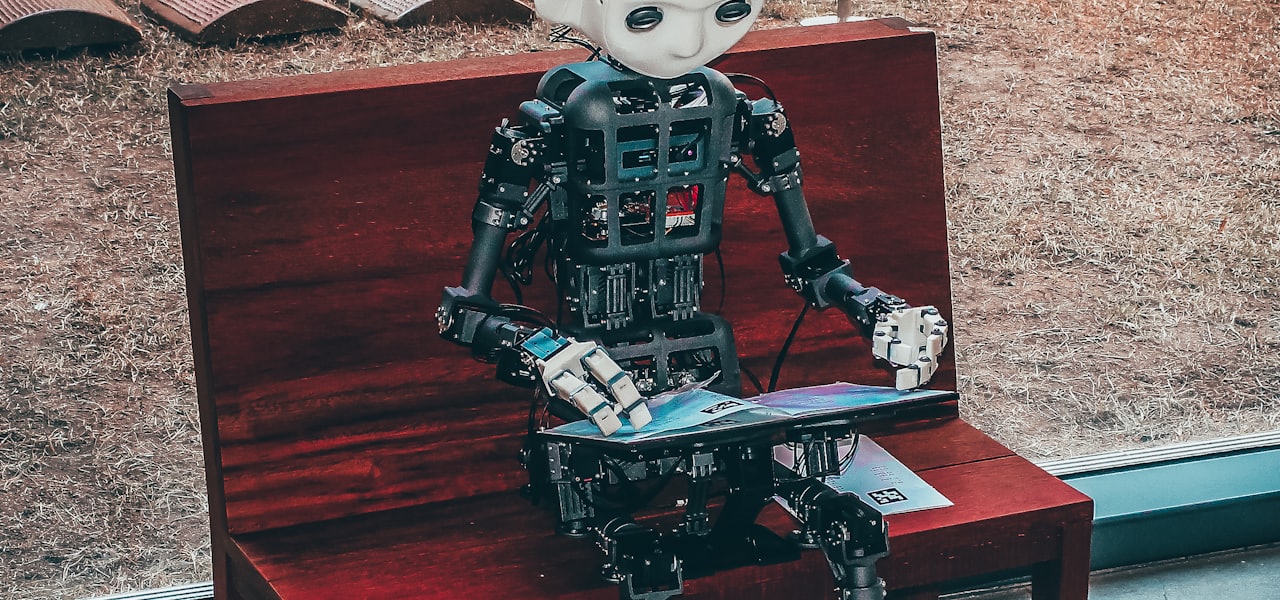
The Turing test, originally called the imitation game by Alan Turing in 1949, is a test of a machine's ability to exhibit intelligent behaviour equivalent to that of a human. In the test, a human evaluator judges a text transcript of a natural-language conversation between a human and a machine. The evaluator tries to identify the machine, and the machine passes if the evaluator cannot reliably tell them apart. The results would not depend on the machine's ability to answer questions correctly, only on how closely its answers resembled those of a human. Since the Turing test is a test of indistinguishability in performance capacity, the verbal version generalizes naturally to all of human performance capacity, verbal as well as nonverbal (robotic). The test was introduced by Turing in his 1950 paper "Computing Machinery and Intelligence" while working at the University of Manchester. It opens with the words: "I propose to consider the question, 'Can machines think?'." Because "thinking" is difficult to define, Turing chooses to "replace the question by another, which is closely related to it and is expressed in relatively unambiguous words". Turing describes the new form of the problem in terms of a three-person party game called the "imitation game", in which an interrogator asks questions of a man and a woman in another room in order to determine the correct sex of the two players. Turing's new question is: "Are there imaginable digital computers which would do well in the imitation game?" This question, Turing believed, was one that could actually be answered. In the remainder of the paper, he argued against the major objections to the proposition that "machines can think". Since Turing introduced his test, it has been highly influential in the philosophy of artificial intelligence, resulting in substantial discussion and controversy, as well as criticism from philosophers like John Searle, who argue against the test's ability to detect consciousness. == History == === Philosophical background === The question of whether it is possible for machines to think has a long history, which is firmly entrenched in the distinction between dualist and materialist views of the mind. René Descartes prefigures aspects of the Turing test in his 1637 Discourse on the Method when he writes: [H]ow many different automata or moving machines could be made by the industry of man ... For we can easily understand a machine's being constituted so that it can utter words, and even emit some responses to action on it of a corporeal kind, which brings about a change in its organs; for instance, if touched in a particular part it may ask what we wish to say to it; if in another part it may exclaim that it is being hurt, and so on. But it never happens that it arranges its speech in various ways, in order to reply appropriately to everything that may be said in its presence, as even the lowest type of man can do. Here Descartes notes that automata are capable of responding to human interactions but argues that such automata cannot respond appropriately to things said in their presence in the way that any human can. Descartes therefore prefigures the Turing test by defining the insufficiency of appropriate linguistic response as that which separates the human from the automaton. Descartes fails to consider the possibility that future automata might be able to overcome such insufficiency, and so does not propose the Turing test as such, even if he prefigures its conceptual framework and criterion. Denis Diderot formulates in his 1746 book Pensées philosophiques a Turing-test criterion, though with the important implicit limiting assumption maintained, of the participants being natural living beings, rather than considering created artifacts: If they find a parrot who could answer to everything, I would claim it to be an intelligent being without hesitation. This does not mean he agrees with this, but that it was already a common argument of materialists at that time. According to dualism, the mind is non-physical (or, at the very least, has non-physical properties) and, therefore, cannot be explained in purely physical terms. According to materialism, the mind can be explained physically, which leaves open the possibility of minds that are produced artificially. In 1936, philosopher Alfred Ayer considered the standard philosophical question of other minds: how do we know that other people have the same conscious experiences that we do? In his book, Language, Truth and Logic, Ayer suggested a protocol to distinguish between a conscious man and an unconscious machine: "The only ground I can have for asserting that an object which appears to be conscious is not really a conscious being, but only a dummy or a machine, is that it fails to satisfy one of the empirical tests by which the presence or absence of consciousness is determined". (This suggestion is very similar to the Turing test, but it is not certain that Ayer's popular philosophical classic was familiar to Turing.) In other words, a thing is not conscious if it fails the consciousness test. === Cultural background === A rudimentary idea of the Turing test appears in the 1726 novel Gulliver's Travels by Jonathan Swift. When Gulliver is brought before the king of Brobdingnag, the king thinks at first that Gulliver might be a "a piece of clock-work (which is in that country arrived to a very great perfection) contrived by some ingenious artist". Even when he hears Gulliver speaking, the king still doubts whether Gulliver was taught "a set of words" to make him "sell at a better price". Gulliver tells that only after "he put several other questions to me, and still received rational answers" the king became satisfied that Gulliver was not a machine. Tests where a human judges whether a computer or an alien is intelligent were an established convention in science fiction by the 1940s, and it is likely that Turing would have been aware of these. Stanley G. Weinbaum's "A Martian Odyssey" (1934) provides an example of how nuanced such tests could be. Earlier examples of machines or automatons attempting to pass as human include the Ancient Greek myth of Pygmalion who creates a sculpture of a woman that is animated by Aphrodite, Carlo Collodi's novel The Adventures of Pinocchio, about a puppet who wants to become a real boy, and E. T. A. Hoffmann's 1816 story "The Sandman," where the protagonist falls in love with an automaton. In all these examples, people are fooled by artificial beings that—up to a point—pass as human. === Alan Turing and the imitation game === Researchers in the United Kingdom had been exploring "machine intelligence" for up to ten years prior to the founding of the field of artificial intelligence (AI) research in 1956. It was a common topic among the members of the Ratio Club, an informal group of British cybernetics and electronics researchers that included Alan Turing. Turing, in particular, had been running the notion of machine intelligence since at least 1941 and one of the earliest-known mentions of "computer intelligence" was made by him in 1947. In Turing's report, "Intelligent Machinery," he investigated "the question of whether or not it is possible for machinery to show intelligent behaviour" and, as part of that investigation, proposed what may be considered the forerunner to his later tests: It is not difficult to devise a paper machine which will play a not very bad game of chess. Now get three men A, B and C as subjects for the experiment. A and C are to be rather poor chess players, B is the operator who works the paper machine. ... Two rooms are used with some arrangement for communicating moves, and a game is played between C and either A or the paper machine. C may find it quite difficult to tell which he is playing. "Computing Machinery and Intelligence" (1950) was the first published paper by Turing to focus exclusively on machine intelligence. Turing begins the 1950 paper with the claim, "I propose to consider the question 'Can machines think?'" As he highlights, the traditional approach to such a question is to start with definitions, defining both the terms "machine" and "think". Turing chooses not to do so; instead, he replaces the question with a new one, "which is closely related to it and is expressed in relatively unambiguous words". In essence he proposes to change the question from "Can machines think?" to "Can machines do what we (as thinking entities) can do?" The advantage of the new question, Turing argues, is that it draws "a fairly sharp line between the physical and intellectual capacities of a man". To demonstrate this approach Turing proposes a test inspired by a party game, known as the "imitation game", in which a man and a woman go into separate rooms and guests try to tell them apart by writing a series of questions and reading the typewritten answers sent back. In this game, both the man and the woman aim to convince the guests that they ar
Infer.NET
Infer.NET is a free and open source .NET software library for machine learning. It supports running Bayesian inference in graphical models and can also be used for probabilistic programming. == Overview == Infer.NET follows a model-based approach and is used to solve different kinds of machine learning problems including standard problems like classification, recommendation or clustering, customized solutions and domain-specific problems. The framework is used in various different domains such as bioinformatics, epidemiology, computer vision, and information retrieval. Development of the framework was started by a team at Microsoft's research centre in Cambridge, UK in 2004. It was first released for academic use in 2008 and later open sourced in 2018. In 2013, Microsoft was awarded the USPTO's Patents for Humanity Award in Information Technology category for Infer.NET and the work in advanced machine learning techniques. Infer.NET is used internally at Microsoft as the machine learning engine in some of their products such as Office, Azure, and Xbox. The source code is licensed under MIT License and available on GitHub. It is also available as NuGet package.
NCover
NCover is a .NET code coverage tool. There are two non-related NCover products that do .NET code coverage. There is an open source NCover that can be found on SourceForge and there is a company called NCover, LLC. There has been additional development on both products since this 2004 reference. The company NCover, LLC began when the founder, Peter Waldschmidt, decided to commercialize the open source tool he created. The commercial versions were launched in 2007, but the last supported free version 1.5.8 is still available on the company site.
Cellular neural network
In computer science and machine learning, Cellular Neural Networks (CNN) or Cellular Nonlinear Networks (CNN) are a parallel computing paradigm similar to neural networks, with the difference that communication is allowed between neighbouring units only. Typical applications include image processing, analyzing 3D surfaces, solving partial differential equations, reducing non-visual problems to geometric maps, modelling biological vision and other sensory-motor organs. CNN is not to be confused with convolutional neural networks (also colloquially called CNN). == CNN architecture == Due to their number and variety of architectures, it is difficult to give a precise definition for a CNN processor. From an architecture standpoint, CNN processors are a system of finite, fixed-number, fixed-location, fixed-topology, locally interconnected, multiple-input, single-output, nonlinear processing units. The nonlinear processing units are often referred to as neurons or cells. Mathematically, each cell can be modeled as a dissipative, nonlinear dynamical system where information is encoded via its initial state, inputs and variables used to define its behavior. Dynamics are usually continuous, as in the case of Continuous-Time CNN (CT-CNN) processors, but can be discrete, as in the case of Discrete-Time CNN (DT-CNN) processors. Each cell has one output, by which it communicates its state with both other cells and external devices. Output is typically real-valued, but can be complex or even quaternion, i.e. a Multi-Valued CNN (MV-CNN). Most CNN processors, processing units are identical, but there are applications that require non-identical units, which are called Non-Uniform Processor CNN (NUP-CNN) processors, and consist of different types of cells. === Chua-Yang CNN === In the original Chua-Yang CNN (CY-CNN) processor, the state of the cell was a weighted sum of the inputs and the output was a piecewise linear function. However, like the original perceptron-based neural networks, the functions it could perform were limited: specifically, it was incapable of modeling non-linear functions, such as XOR. More complex functions are realizable via Non-Linear CNN (NL-CNN) processors. Cells are defined in a normed gridded space like two-dimensional Euclidean geometry. However, the cells are not limited to two-dimensional spaces; they can be defined in an arbitrary number of dimensions and can be square, triangle, hexagonal, or any other spatially invariant arrangement. Topologically, cells can be arranged on an infinite plane or on a toroidal space. Cell interconnect is local, meaning that all connections between cells are within a specified radius (with distance measured topologically). Connections can also be time-delayed to allow for processing in the temporal domain. Most CNN architectures have cells with the same relative interconnects, but there are applications that require a spatially variant topology, i.e. Multiple-Neighborhood-Size CNN (MNS-CNN) processors. Also, Multiple-Layer CNN (ML-CNN) processors, where all cells on the same layer are identical, can be used to extend the capability of CNN processors. The definition of a system is a collection of independent, interacting entities forming an integrated whole, whose behavior is distinct and qualitatively greater than its entities. Although connections are local, information exchange can happen globally through diffusion. In this sense, CNN processors are systems because their dynamics are derived from the interaction between the processing units and not within processing units. As a result, they exhibit emergent and collective behavior. Mathematically, the relationship between a cell and its neighbors, located within an area of influence, can be defined by a coupling law, and this is what primarily determines the behavior of the processor. When the coupling laws are modeled by fuzzy logic, it is a fuzzy CNN. When these laws are modeled by computational verb logic, it becomes a computational verb CNN. Both fuzzy and verb CNNs are useful for modelling social networks when the local couplings are achieved by linguistic terms. == History == The idea of CNN processors was introduced by Leon Chua and Lin Yang in 1988. In these articles, Chua and Yang outline the underlying mathematics behind CNN processors. They use this mathematical model to demonstrate, for a specific CNN implementation, that if the inputs are static, the processing units will converge, and can be used to perform useful calculations. They then suggest one of the first applications of CNN processors: image processing and pattern recognition (which is still the largest application to date). Leon Chua is still active in CNN research and publishes many of his articles in the International Journal of Bifurcation and Chaos, of which he is an editor. Both IEEE Transactions on Circuits and Systems and the International Journal of Bifurcation also contain a variety of useful articles on CNN processors authored by other knowledgeable researchers. The former tends to focus on new CNN architectures and the latter more on the dynamical aspects of CNN processors. In 1993, Tamas Roska and Leon Chua introduced the first algorithmically programmable analog CNN processor in the world. The multi-national effort was funded by the Office of Naval Research, the National Science Foundation, and the Hungarian Academy of Sciences, and researched by the Hungarian Academy of Sciences and the University of California. This article proved that CNN processors were producible and provided researchers a physical platform to test their CNN theories. After this article, companies started to invest into larger, more capable processors, based on the same basic architecture as the CNN Universal Processor. Tamas Roska is another key contributor to CNNs. His name is often associated with biologically inspired information processing platforms and algorithms, and he has published numerous key articles and has been involved with companies and research institutions developing CNN technology. === Literature === Two references are considered invaluable since they manage to organize the vast amount of CNN literature into a coherent framework: An overview by Valerio Cimagalli and Marco Balsi. The paper provides a concise intro to definitions, CNN types, dynamics, implementations, and applications. "Cellular Neural Networks and Visual Computing Foundations and Applications", written by Leon Chua and Tamas Roska, which provides examples and exercises. The book covers many different aspects of CNN processors and can serve as a textbook for a Masters or Ph.D. course. Other resources include The proceedings of "The International Workshop on Cellular Neural Networks and Their Applications" provide much CNN literature. The proceedings are available online, via IEEE Xplore, for conferences held in 1990, 1992, 1994, 1996, 1998, 2000, 2002, 2005 and 2006. There was also a workshop held in Santiago de Composetela, Spain. Topics included theory, design, applications, algorithms, physical implementations and programming and training methods. For an understanding of the analog semiconductor based CNN technology, AnaLogic Computers has their product line, in addition to the published articles available on their homepage and their publication list. They also have information on other CNN technologies such as optical computing. Many of the commonly used functions have already been implemented using CNN processors. A good reference point for some of these can be found in image processing libraries for CNN based visual computers such as Analogic’s CNN-based systems. == Related processing architectures == CNN processors could be thought of as a hybrid between artificial neural network (ANN) and Continuous Automata (CA). === Artificial Neural Networks === The processing units of CNN and NN are similar. In both cases, the processor units are multi-input, dynamical systems, and the behavior of the overall systems is driven primarily through the weights of the processing unit’s linear interconnect. However, in CNN processors, connections are made locally, whereas in ANN, connections are global. For example, neurons in one layer are fully connected to another layer in a feed-forward NN and all the neurons are fully interconnected in Hopfield networks. In ANNs, the weights of interconnections contain information on the processing system’s previous state or feedback. But in CNN processors, the weights are used to determine the dynamics of the system. Furthermore, due to the high inter-connectivity of ANNs, they tend not exploit locality in either the data set or the processing and as a result, they usually are highly redundant systems that allow for robust, fault-tolerant behavior without catastrophic errors. A cross between an ANN and a CNN processor is a Ratio Memory CNN (RMCNN). In RMCNN processors, the cell interconnect is local and topologically invariant, but the weights are used to store